Project Overview
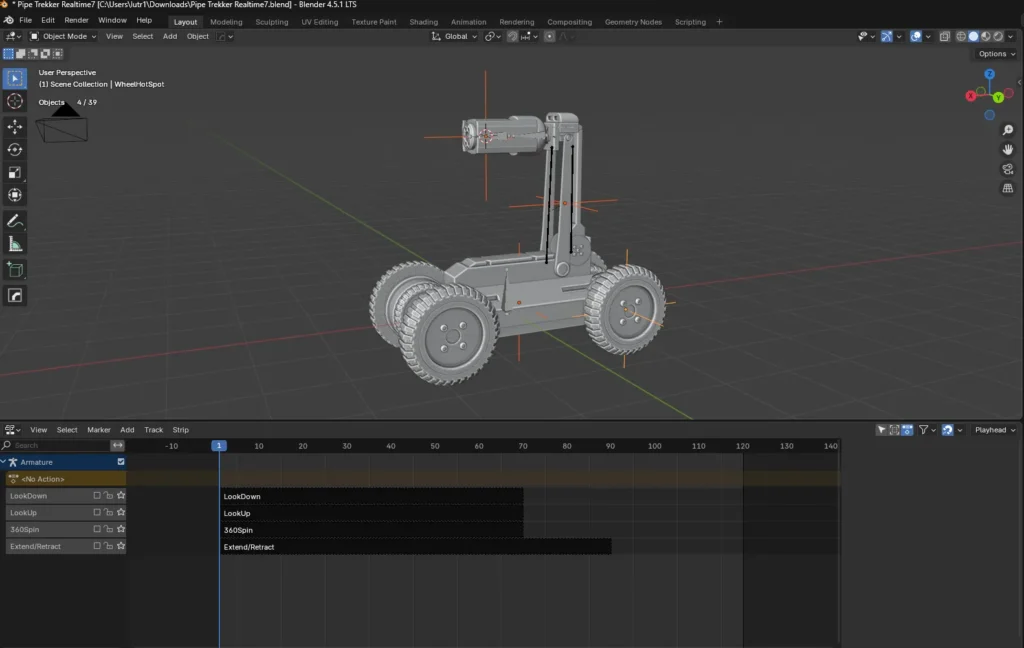
During my 6th stay at 3D College Denmark, I created a realtime, web‑based 3D viewer for the A‑200 Pipe Crawler drone from Pipe Trekker, a company under Deep Trekker Inc. This project served as a small proof of concept and was my first attempt at combining 3D modeling with interactive web development.
Tools and Technologies
I used Three.js for the 3D rendering and interactive controls, alongside standard web technologies such as HTML, CSS, and JavaScript. I also leveraged ChatGPT‑5 to help with code structure and debugging, which significantly sped up the initial development phase. However, the assistant sometimes lost coherence or suggested features that didn’t fit the project scope, so the later stages required careful review and manual refinement.
Reflection
The project was far from perfect, but it turned out to be a valuable learning experience. The final days of the second week were mostly occupied with fine‑tuning, performance optimization, and extensive debugging. Despite the challenges, I gained insight into how 3D modeling, animation, and web development can be integrated into a single workflow, and how AI can support—but not replace—the creative and technical decision‑making process.
Workflow
The project was completed over two intensive weeks. In the first week, I focused on modeling and animating the Pipe Crawler, as well as optimizing the geometry and materials for realtime use in the browser. The second week was dedicated to building the website and implementing the JavaScript logic that powers the viewer and interaction.